Solar Lighting Insights for South Africa
Solar Road Studs in South Africa: Improving Road Visibility with Solar Q Lighting
South African roads can present challenging driving conditions, particularly at night or during fog, mist and heavy rain. Solar LED road studs offer a way to improve road visibility by providing active illumination rather than relying solely on reflected headlights.
How are solar road studs different?
Traditional reflective road studs, or “cat’s eyes,” rely on vehicle headlights to reflect light back to approaching drivers.
Solar LED road studs use a solar panel and rechargeable battery to power LEDs, which automatically illuminate in low-light conditions. This active lighting improves visibility and provides clearer guidance at bends, road edges, intersections, and other hazardous locations.
Solar Q Lighting: Solar-powered cat’s eyes
Solar Q Lighting provides solar-powered LED road studs that deliver active illumination for roads and traffic applications.
Using solar charging, energy storage and LED technology, these solar “cat’s eyes” provide visibility without relying solely on vehicle headlights.
They offer road authorities, contractors and infrastructure projects an additional solution for improved road delineation where greater visibility is required.
Where could solar road studs be useful in South Africa?
South Africa has an extensive and diverse road network, creating many different environments where improved visibility may be beneficial.
Potential applications include:
Mountain passes and sharp bends
Illuminated studs can help define the road alignment and highlight changes in direction, particularly on winding roads and mountain passes.
Fog and mist-prone areas
Where conventional road markings become harder to see, active illumination can provide an additional visual cue for drivers.
Intersections and ramps
Solar LED studs can potentially highlight lane divisions, ramps, entrances and other changes in road layout.
Pedestrian and cycling areas
Depending on the road design and applicable standards, illuminated markers can also be considered where additional visibility for vulnerable road users is required.
Reliable Light Where Infrastructure Needs It Most
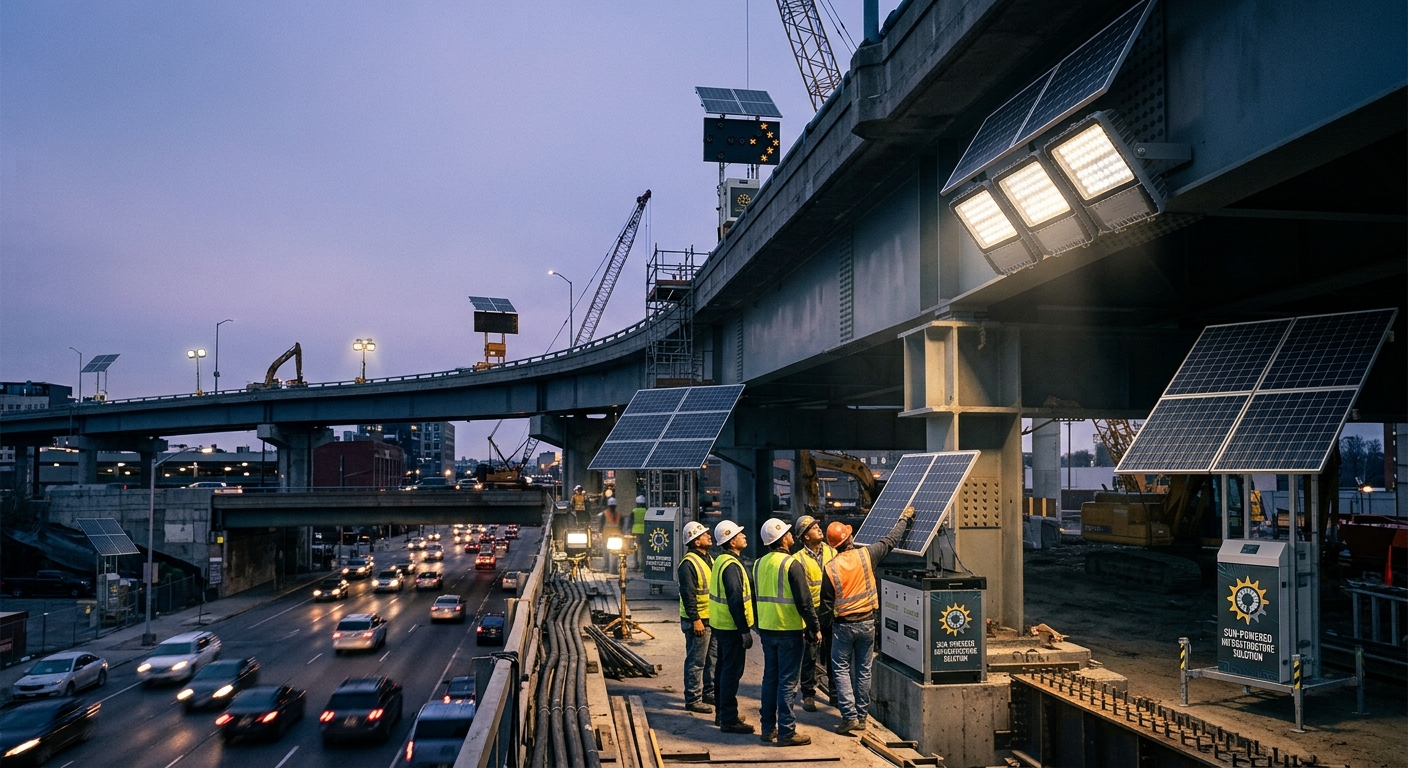
Solar lighting delivers dependable illumination without the expense and disruption of trenching, cabling or ongoing grid consumption. Modern systems store solar energy for night-time use, helping roads, access routes, work zones and remote sites remain visible during critical hours.
Reliability: Self-contained solar lighting is ideal for locations where grid access is limited, unreliable or costly to install. Efficient LED luminaires and correctly sized battery storage provide consistent after-dark lighting for everyday operations and temporary project needs.
Environmental impact: By generating power from the sun, solar lighting reduces reliance on fossil-fuel-generated electricity and eliminates diesel generator emissions, noise and fuel transport. It is a practical way to support lower-impact infrastructure development.
Cost savings: With no monthly electricity use and minimal maintenance requirements, solar lighting can reduce lifetime operating costs. Faster installation also limits labour, excavation and site disruption, allowing teams to allocate budgets more effectively.
Practical applications: From roads, intersections and pedestrian areas to construction compounds, parking areas, security perimeters and rural facilities, solar lighting brings adaptable visibility to the places that need it most.
Solar Lighting Facts for South African Projects
South Africa’s strong solar resource and continuing infrastructure requirements make solar-powered lighting a practical option for improving visibility, reducing operating costs and supporting resilient development.
More Than 2,500 Hours of Sunshine
Much of South Africa receives over 2,500 sunshine hours annually, providing a strong natural resource for charging solar lighting systems throughout the year.
Lighting Supports Safer Work and Travel
Clear, consistent illumination helps drivers identify road edges, pedestrians and hazards, while well-lit construction areas improve task visibility and help teams work more safely after dark.
Solar Lighting FAQs for South African Projects
Find practical answers about choosing, installing and maintaining dependable solar lighting for roads, work zones and infrastructure projects across South Africa.
How well do solar lights perform during cloudy weather?
Quality solar lighting systems are designed with battery storage to keep operating after cloudy days. Performance depends on the solar resource, panel size, battery capacity, lighting profile and site conditions, so each project should be assessed to ensure reliable autonomy.
Can solar lighting be used on South African roads and rural routes?
Yes. Solar lighting is well suited to rural roads, intersections, pedestrian crossings, bus stops and remote routes where grid power is unavailable, costly or difficult to extend. It can improve visibility and safety without trenching for electrical cables.
What is involved in installing solar street or construction lights?
Installation is typically faster than conventional lighting because there is no need for grid connection or underground cabling. The process includes a site assessment, suitable foundation and pole installation, solar orientation, system commissioning and checks for clear sunlight exposure.
How much maintenance do solar lighting systems require?
Solar lighting requires relatively low maintenance. Routine inspections should include cleaning panels when dust accumulates, checking the luminaire and pole condition, confirming battery performance and removing any vegetation or obstructions that shade the panel.
Are solar lights weather-resistant enough for South African conditions?
Purpose-built solar luminaires are engineered for outdoor exposure, including heat, rain, wind and dust. Select products with appropriate IP and impact ratings, corrosion-resistant materials and a design suited to the specific coastal, inland or high-wind environment.
Can solar lighting improve security around construction sites?
Yes. Well-positioned solar lighting can illuminate access points, site boundaries, storage areas, walkways and parking zones after dark. Better visibility can support safer movement, deter unauthorised access and complement existing site-security measures.
Will solar lights work during load shedding or power outages?
Yes. As standalone systems, solar lights generate and store their own energy, so they can continue operating when the grid is unavailable. This makes them a valuable resilience measure for critical roads, public spaces and construction sites.
How long do solar lighting batteries and LEDs last?
LED luminaires generally provide many years of service, while battery life varies according to technology, usage, climate and charging conditions. A professionally specified system should include a maintenance plan and allow for battery replacement at the appropriate interval.
Can solar lighting be tailored to a specific project?
Yes. Lighting solutions can be configured around road width, mounting height, required illumination, operating hours, traffic activity, security needs and local weather conditions. Site-specific planning helps deliver efficient, dependable performance for the application.